What is Finite Element Analysis (FEA) and When Do You Need It?
Finite Element Analysis: Using FEA Simulation to Optimise NZ Product Design
Key Takeaways
- FEA serves as a digital testing ground that allows engineers to simulate stress, heat, and vibration before physical manufacturing begins.
- Using simulation software significantly reduces the need for expensive physical prototypes and accelerates the path to market.
- Structural analysis remains the most common application of the finite element method, while thermal analysis is seeing rapid growth globally.
- New Zealand manufacturers use these tools to ensure compliance with local standards and to support design verification for certification.
- Integrating FEA into the early design process helps identify potential failures, saving significant costs on rework and material waste.
In our experience, the most successful New Zealand manufacturing projects share a common trait: they are "broken" and fixed digitally long before a single piece of steel is cut or a gram of plastic is injected. We achieve this through Finite Element Analysis (FEA), a sophisticated numerical method used for the prediction of how a part or assembly behaves under given conditions. By breaking a complex object into millions of tiny, manageable pieces called finite elements, we can simulate real-world forces with incredible precision.
The global FEA market was valued at US$8.32 billion in 2025 and is projected to reach US$16.36 billion by 2034. This growth represents a 7.8% Compound Annual Growth Rate. This steady rise shows that FEA is a mainstream engineering tool globally, with the Asia-Pacific region alone accounting for 38.2% of global revenue in 2025. For New Zealand businesses, adopting these methods ensures they remain aligned with international best practices in advanced manufacturing.
What is Finite Element Analysis and How Does it Work?
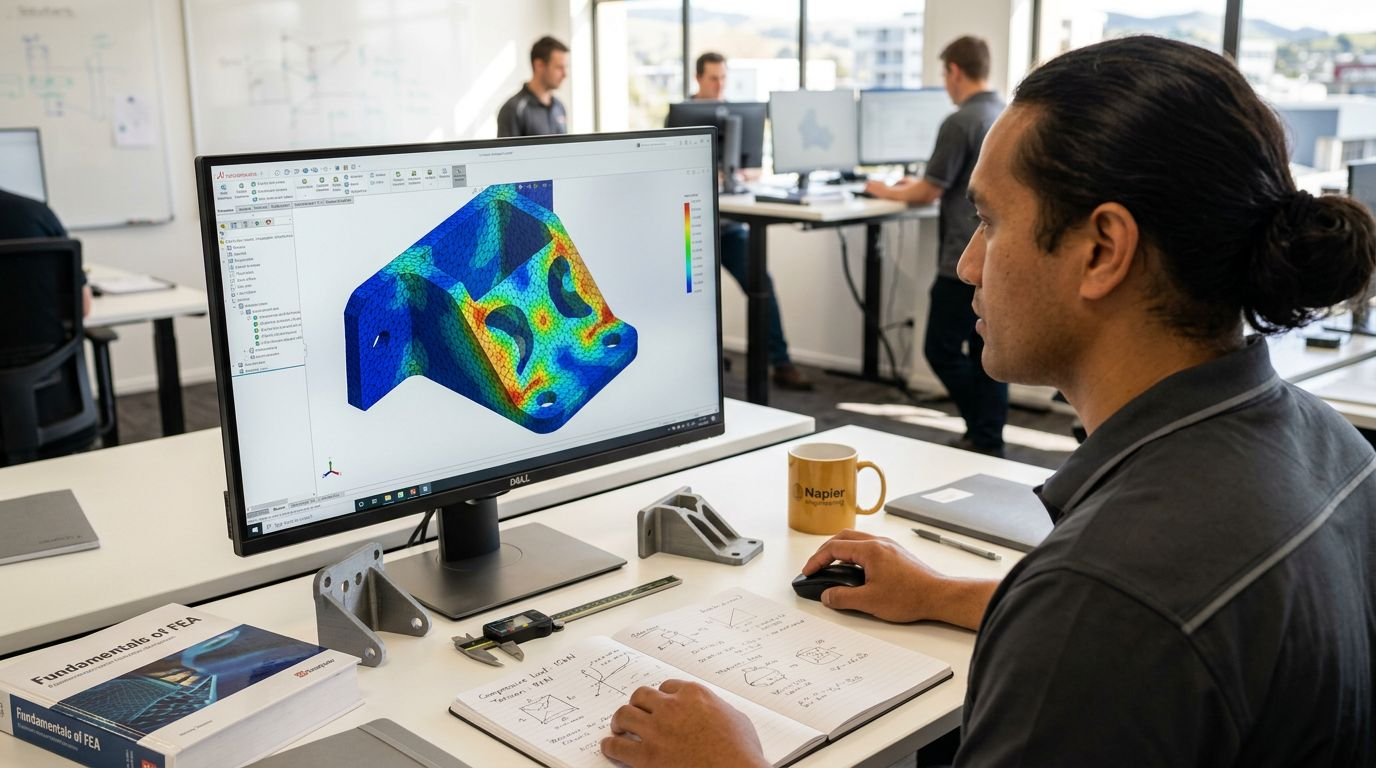
Finite Element Analysis is a numerical simulation technique based on the finite element method (FEM). It allows an engineer to predict how products react to real-world forces such as heat, fluid flow, and structural loads. Instead of relying on guesswork or over-engineering a part to ensure it stays in one piece, we use FEA software to create a mathematical model of the component. This model helps us understand the internal stresses and strains that occur when the part is put to work.
Engineers use FEA software to reduce the number of physical prototypes and experiments and optimise components in their design phase. This process saves expenses and allows for the development of better products at a much faster pace. The core of the analysis involves taking a complex geometry and dividing it into a finite element mesh. This mesh is a collection of simple shapes, like triangles or tetrahedrons, which are connected at points called nodes. By solving a partial differential equation for each element, the software calculates how the entire structure will behave.
A partial differential equation is a type of mathematical equation that describes how a physical quantity, like heat or pressure, changes over space and time. While these equations are incredibly complex to solve by hand, modern computational power allows us to process millions of these calculations in minutes. This mathematical method provides a level of detail that physical testing often cannot match, showing us exactly where a part might crack or deform under load.
Why FEA Matters for New Zealand Manufacturing
The New Zealand manufacturing landscape is unique, often characterised by high-value, niche products and a need for extreme flexibility. We have seen that local companies often face tight margins and high material costs, making physical prototyping a significant financial burden. By using FEA, we allow businesses to be creative and flexible with their ideas before engaging in expensive prototyping and manufacturing processes. This approach is a core part of our mechanical design and drafting services, where we focus on delivering practical results for local industry.
New Zealand currently faces a challenge in the engineering sector, needing an additional 2,500 engineers annually to meet demand. This shortage puts pressure on existing teams to work more efficiently. By using simulation tools, we can do more with less. Instead of a team spending weeks building and testing three different physical iterations of a machine, we can test thirty iterations in a virtual environment. This efficiency is vital for maintaining the momentum of innovation in sectors like AgriTech, construction, and heavy machinery.
We believe that a structured design process involving CAD modelling, analysis, and verification is the most reliable way to bring a concept to reality. Our work is built around a core of design verification and preparation for certification to ensure compliance with local New Zealand requirements. FEA provides the documented evidence needed to satisfy certification engineers that a design is safe and fit for purpose, which is especially critical for safety-sensitive equipment used in our primary industries.
The Different Types of Finite Element Analysis
Not every engineering problem is the same, and therefore, not every FEA simulation uses the same approach. Depending on the specific engineering requirements, we might employ several different types of analysis to get the full picture of a product's performance. Structural analysis is the most common, accounting for 55.83% of the FEA software market by application in 2025. This type of analysis looks at how a structure handles loads like Compression, Tension and Pressure.
Thermal analysis is another critical area, and it is currently the fastest-growing segment of the market. We use thermal analysis to simulate how heat moves through a part, which is essential for electronics, engines, and food processing equipment. Seeing how material properties change as temperatures rise allows us to prevent warping or melting before a physical prototype is even built. Other common types of analysis include vibration analysis (or modal analysis), which identifies the natural frequencies of a part to prevent it from shaking itself to pieces, and fluid dynamics, which looks at how liquids and gases flow around or through a design.
By simulating real-world conditions digitally, FEA reduces development time and lowers costs while accelerating product development cycles. Whether we are looking at the displacement of a structural beam or the heat dissipation in a new piece of electronics, these tools allow us to refine the geometry and material choices to achieve the best possible performance. This predictive analysis is a far cry from the "build it and see" methods of the past.
Integrating FEA into the Design and Analysis Process
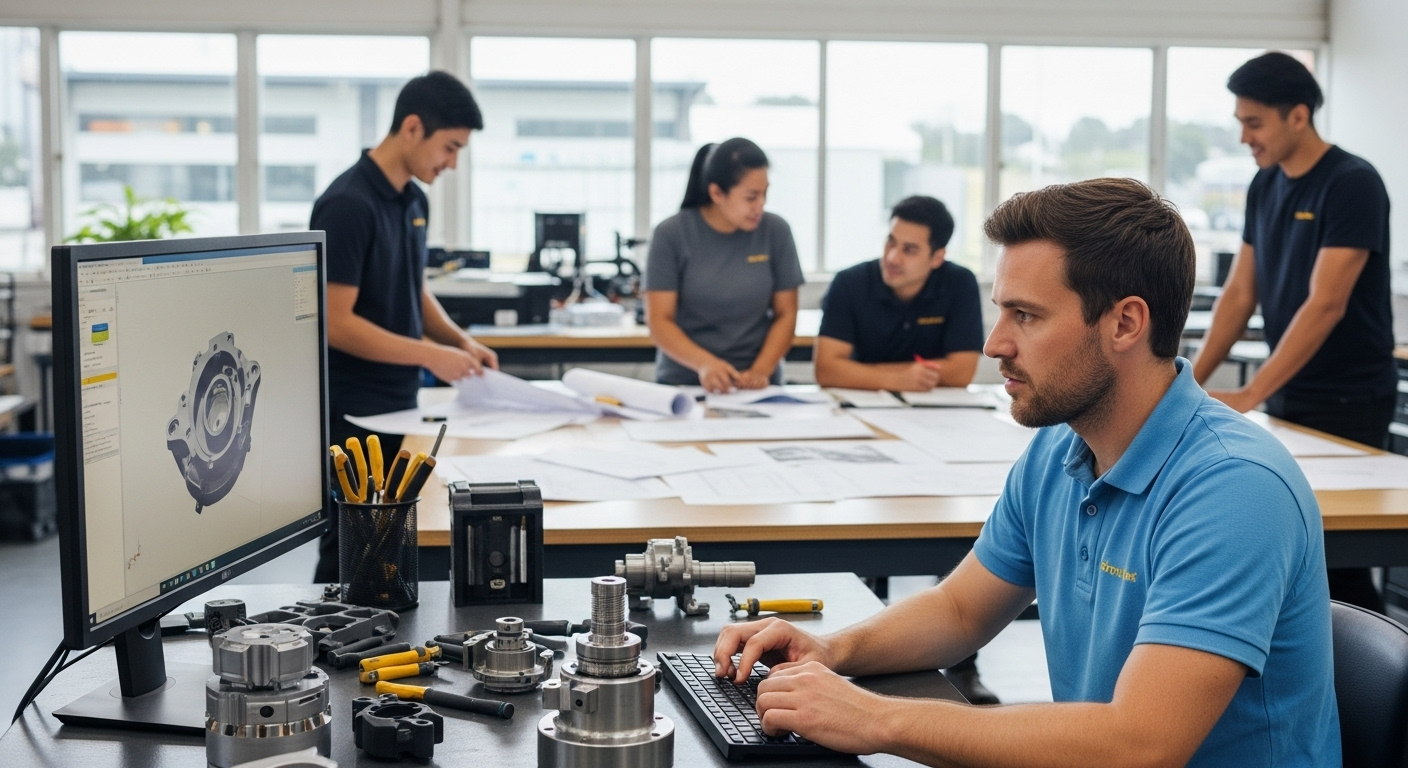
In our workflow, FEA is not a standalone task that happens at the end of a project. Instead, it is an integrated part of the design and analysis cycle. We start with a CAD model, which is the digital blueprint of the part. From there, we prepare the model for simulation by simplifying certain features that do not affect the structural integrity, a process known as "de-featuring." This makes the computational work more efficient without sacrificing accuracy.
Once the model is ready, we apply boundary conditions. These are the constraints and loads that represent how the part will be used in real life. For example, if we are analysing a mounting bracket for a tractor, we would fix the points where it bolts to the frame and apply a force to the point where it supports a load. We also define the material properties, such as the stiffness and strength of the specific grade of steel or aluminium being used. The software then generates the FEA results, which are often displayed as a colour-coded map showing areas of high stress or high temperature.
Combining FEA with modern manufacturing workflows like CNC machining and 3D printing allows us to virtually test and refine designs before creating physical prototypes. This saves valuable time and ensures that when we finally do move to production, the design is already optimised. We have seen this approach work across various industries, from automotive components to complex industrial machinery, providing a level of confidence that traditional methods simply cannot match.
Avoiding Costly Mistakes Through Simulation
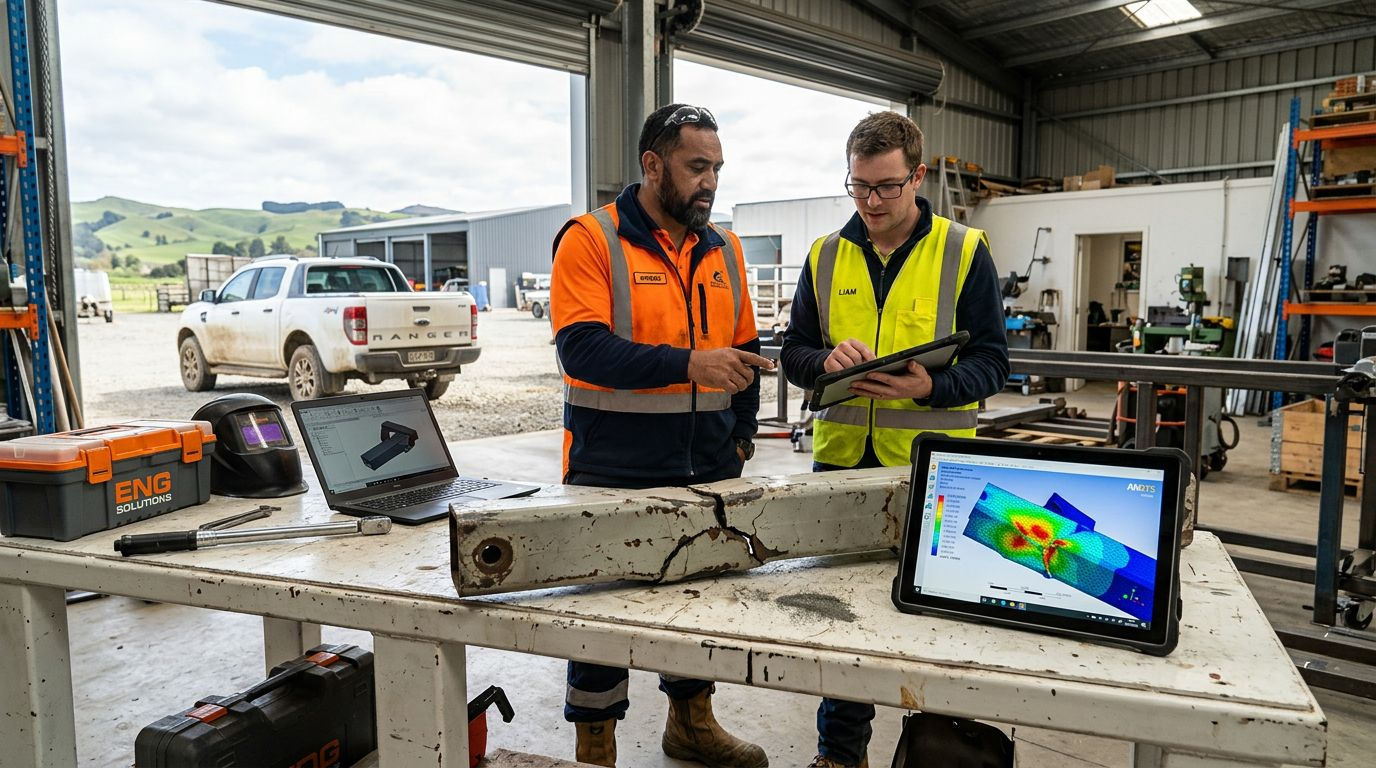
Many of the most expensive failures in mechanical design could have been prevented with early simulation. A common mistake we observe is waiting until a physical failure occurs during testing before looking for the root cause. This leads to rework, wasted materials, and delays in product launches. By using flow and stress simulations during the design phase, we can predict performance and identify design flaws when they are still just lines on a screen.
We recommend that businesses use these tools to avoid costly mechanical design mistakes by providing expert guidance and detailed engineering support throughout the process. FEA allows us to perform "what-if" scenarios. What if we use a thinner gauge of steel? What if the operating temperature increases by twenty degrees? What if the vibration frequency changes? Answering these questions digitally is significantly cheaper than answering them through a series of failed physical tests.
The future of FEA is moving toward even greater integration with the design process, making these tools more accessible to engineers throughout the entire development cycle. As software becomes more powerful and user-friendly, the ability to perform complex structural or fluid simulations will become a standard requirement for any New Zealand company looking to compete on a global scale. We are already seeing this shift as organisations embed simulation into their digital transformation and Industry 4.0 workflows.
Practical Applications in the New Zealand Context
To understand how this applies locally, take a manufacturer of agricultural equipment in the Waikato, for example. If they are developing a new type of harvester, they need to ensure the frame can withstand the constant vibration and uneven loads of a paddock without cracking. By using vibration analysis and structural mechanics simulations, we can identify the exact spots where the frame needs reinforcement and where material can be removed to save weight and cost. This results in a lighter, stronger, and more fuel-efficient machine.
Similarly, a company designing outdoor lighting for a coastal environment in Christchurch would benefit from thermal analysis. They need to ensure that the heat generated by the LEDs can dissipate effectively even on a hot summer day, while also accounting for the structural loads imposed by high winds. FEA gives us the data to prove the design will last for years in harsh conditions, reducing the risk of warranty claims and brand damage. In both cases, the cost of the FEA simulation is a fraction of the cost of a product recall or a major structural failure in the field.
While costs for FEA services can vary depending on the complexity of the part and the type of analysis required, the return on investment is usually clear. The savings in material costs, prototyping time, and compliance testing often pay for the analysis many times over. For New Zealand businesses, this is not just about using fancy software; it is about making smarter, data-driven decisions that lead to better products and a more resilient manufacturing sector.
The Relationship Between FEA and FEM
People often ask about the difference between FEA and FEM. While the terms are often used interchangeably, there is a technical distinction. The Finite Element Method (FEM) is the actual mathematical method used to solve the problems, while Finite Element Analysis (FEA) is the application of that method to study a physical phenomenon. You can think of FEM as the engine and FEA as the act of driving the car to a specific destination. Both are essential for modern engineering applications.
In our work, we use various FEA tools and FEM software to tackle mechanics problems that would be impossible to solve by other means. Whether it is a simple static stress analysis or a complex non-linear dynamic simulation, the underlying principles remain the same. We take a large, complex problem and break it down into small, solvable pieces. This approach has become the gold standard for design and analysis across the globe, and it is a standard we are proud to uphold for our clients here in New Zealand.
We have seen that businesses that embrace these technologies early in their development cycle are the ones that lead their industries. They are the ones who can confidently stand behind their products, knowing that every bolt, beam, and weld has been verified through rigorous digital testing. As we look toward the future, the role of FEA in New Zealand engineering will only continue to grow, helping our local innovators turn their most ambitious ideas into reality.
If you are looking to improve your design process and reduce the need for physical testing, we are here to help. Our team combines years of experience with the latest simulation tools to provide practical, business-focused engineering support. Whether you are in the early concept stage or preparing for final certification, we can provide the analysis and verification you need to succeed in the competitive New Zealand manufacturing landscape.