What is Design for Manufacturing (DFM)? Bridging the Gap Between Concept and Reality
Design for Manufacture and Manufacturability for New Zealand Businesses
Key Takeaways
- Most of a product’s lifetime cost is locked in during the initial design phase.
- Simplifying part counts can reduce assembly time and potential failure points.
- Aligning designs with local manufacturing constraints ensures commercial viability.
- Design independence allows businesses to choose the best suppliers for their needs.
- Small tweaks in CAD geometry can lead to significant savings in machining costs.
Design for Manufacturing, often abbreviated as DFM, represents the critical bridge between a clever concept and a commercially viable product. For many New Zealand innovators, the journey from a brilliant idea to a physical item sitting on a shelf or operating in a factory is filled with unexpected hurdles. We often see great designs that look perfect in a digital environment but become prohibitively expensive or physically impossible to produce once they reach the factory floor. This gap exists because a design must account for the realities of the machines, materials, and people that will eventually build it.
In our experience, the most successful projects are those where manufacturing feasibility is a primary consideration from the very first sketch. Treating production as an integral part of the design process ensures that your product is straightforward, repeatable, and cost-effective to manufacture within our local constraints. This approach is particularly vital in the New Zealand market, where we often deal with smaller production runs and specific logistical challenges. By focusing on DFM, we help Kiwi businesses move from a prototype to a market-ready reality without the common pitfalls of late-stage redesigns.
What is Design for Manufacture?
Design for Manufacturing is an engineering methodology that integrates manufacturing constraints into the earliest stages of the design process. It focuses on optimising the relationship between the design of a product and the methods used to create it. According to research from Fractory, DFM falls under the broader umbrella of Design for Excellence (DFX), aiming to make products easier, cheaper, and faster to manufacture while maintaining high quality.
The goal is to identify and resolve potential manufacturing issues before they become expensive problems. This involves a deep understanding of the manufacturing process, the materials being used, and the environment where the product will eventually serve. When we talk about DFM, we are looking at how to refine a product’s design to ensure it can be produced with the highest efficiency and the lowest possible risk. This is a proactive strategy that replaces the old "throw it over the wall" approach, where designers would finish a CAD model and simply hope the manufacturing team could find a way to build it.
The Critical 70 Percent Rule
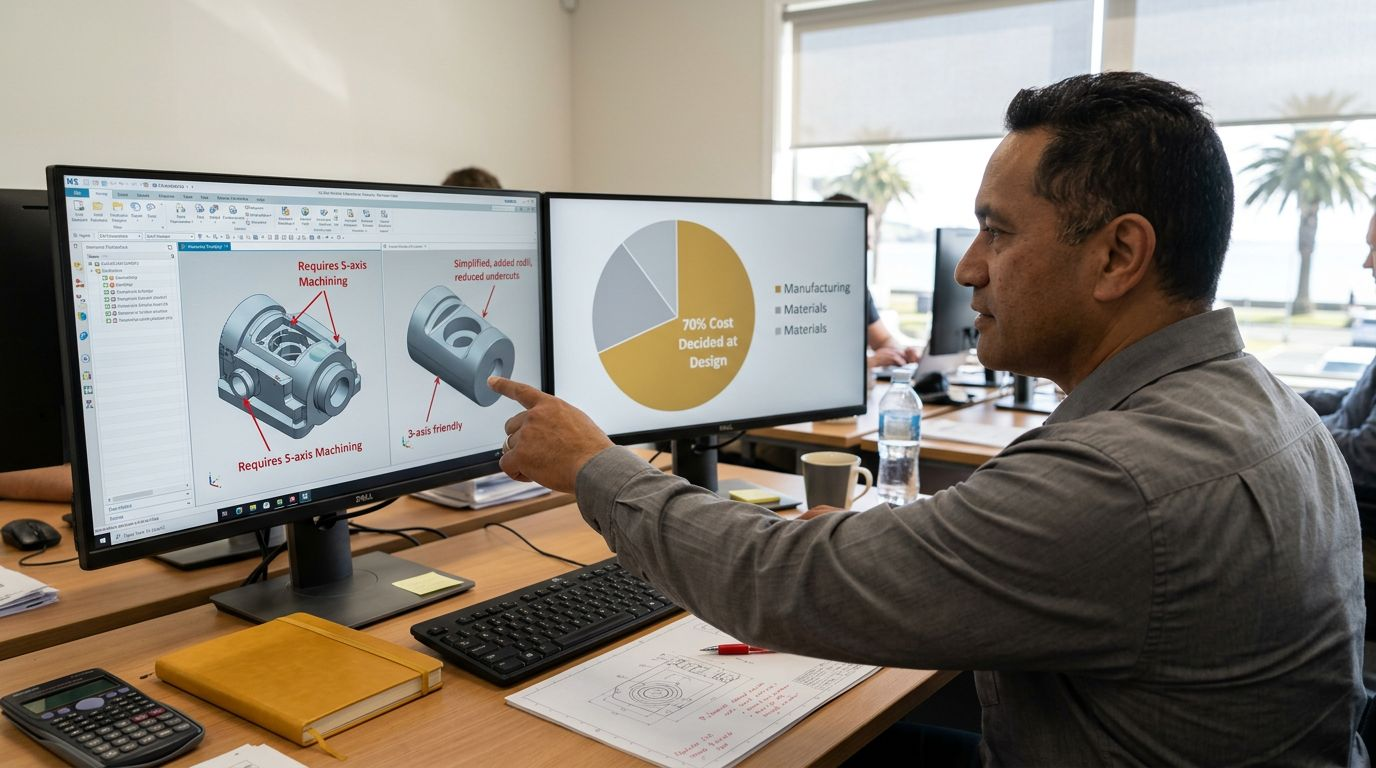
One of the most compelling reasons to invest in professional design early is the impact on your bottom line. Research shows that over 70% of a product’s cost is determined at the design stage. This means that by the time you have a finished set of drawings, the majority of your manufacturing, material, and assembly costs are already locked in. Trying to find savings once production has started is often a losing battle because the fundamental design choices have already dictated the price.
We find that many businesses focus their cost-cutting efforts on the factory floor, looking for cheaper labor or faster machines. However, the real leverage lies in the design office. A design that requires five-axis CNC machining when a simple three-axis setup would suffice creates unnecessary costs that no amount of factory efficiency can erase. By making smart decisions during the initial design phase, we help you secure the commercial viability of your product before you even cut the first piece of metal.
The New Zealand Manufacturing Landscape
New Zealand’s manufacturing sector is a powerhouse of the local economy, contributing significantly to our national prosperity. Manufacturing accounts for 10 to 11.5% of GDP and roughly 60% of our exports. Despite this strength, many local firms face a technology adoption gap. For instance, New Zealand’s robot density sits at about 55 robots per 10,000 workers, which is considerably lower than the 371 found in Germany or the 934 in South Korea. This context makes DFM even more important for Kiwi businesses.
When we design for the local market, we must account for the specific capabilities of New Zealand suppliers. We focus on creating mechanical design and drafting services that produce modern manufacturing files tailored to these local realities. This includes providing detailed manufacturing drawings for suppliers, ensuring that your parts are "fit for purpose" and can be produced reliably by the partners you choose to work with. Our emphasis on drawing revision control ensures that as your product evolves, the manufacturing data remains accurate and accessible.
The Role of R&D in Modern Design
The commitment to innovation in New Zealand is growing steadily. Statistics show that NZ R&D spending reached $6.4 billion in 2024, representing a 21% increase over just two years. With 63% of this investment driven by the business sector, it is clear that Kiwi companies are looking for ways to stay competitive. A structured product design process is the best way to ensure this R&D investment yields a return.
We view the path from idea to market as a series of deliberate steps: research and validation, CAD design and engineering, prototyping, and finally, compliance and manufacturing. By weaving DFM principles into the CAD design stage, we avoid the "prototype loop" where a design works as a one-off but fails when scaled for production. This structured approach helps transform a vision into a market-ready reality while managing the risks inherent in new product development.
Principles of Design for Manufacturing
Implementing DFM effectively requires following a set of core principles that guide every design decision. These principles are not about limiting creativity, but rather about providing a framework that ensures the final product is practical to build.
Process Selection and Material Optimisation
Choosing the right manufacturing process early is vital. Whether you are using additive manufacturing (3D printing), injection moulding, or CNC machining, the design must reflect the strengths and limitations of that specific method. For example, a part designed for 3D printing might have complex internal lattices that are impossible to create using traditional milling. We help you select the materials and manufacturing processes that balance performance with cost.
Design Simplification and DFMA
Design for Manufacturing and Assembly, or DFMA, takes things a step further by looking at how parts come together. One of the most effective ways to reduce costs is to reduce the number of parts in a product. Studies show that DFMA adoption can lead to average part-count reductions of 54%. Fewer parts mean fewer assembly steps, less inventory to manage, and fewer things that can go wrong during production.
Take a kitchen appliance manufacturer like Whirlpool, for instance. By adopting DFMA principles, they achieved 29% fewer parts and a 26% reduction in assembly time for a single product line. In a New Zealand context, this might mean designing a custom bracket that replaces three separate standard components, simplifying the assembly process for a local workshop.
Standardisation of Features
Using standard components and features is a hallmark of good DFM. If your design uses standard bolt sizes, common material thicknesses, and uniform hole diameters, you reduce the need for specialized tooling and custom setups. This standardisation makes it easier for suppliers to quote on your work and reduces the lead time for getting parts made.
Small Changes with Big Financial Impact
In many engineering projects, the difference between an expensive part and an affordable one comes down to minor geometric details. We often see how simple DFM changes can reduce machining costs by 20% to 50%. These are not massive overhauls but intelligent refinements based on how machines actually work.
Consider a simple CNC-milled component. A designer might specify sharp internal corners because they look clean in a CAD model. However, a milling bit is round, and creating a sharp corner requires a much slower, more expensive process or specialised tooling. By simply increasing the internal corner radii to match standard tool sizes, the machining time drops significantly. Similarly, relaxing tolerances on non-critical dimensions allows for faster production speeds without affecting the part’s performance. We apply these types of manufacturability reviews to every project, ensuring that our clients are not paying for unnecessary precision.
Design Independence and Supplier Flexibility
One of the core values we provide is design independence. We believe that you should own your intellectual property and have the freedom to choose your manufacturing partners. By creating high-quality, independent design files and manufacturing drawings, we ensure you are not locked into a single supplier’s proprietary system. This allows you to seek competitive pricing and mitigate the risk of supply chain disruptions.
Whether you are a startup in Wellington or an established manufacturer in Auckland, having the ability to take your drawings to any competent machine shop is a major strategic advantage. It puts the power back in your hands and ensures that your production remains flexible as your business grows. This approach also makes it easier to manage drawing revision control, as you have a single "source of truth" for your product’s design that you control.
Compliance and Certification in New Zealand
Navigating the regulatory landscape is a significant part of the product development journey. In New Zealand, ensuring that a product meets local standards and certifications is non-negotiable, especially for mechanical equipment and structural components. We integrate design verification and preparation for certification into our workflow. This means that when your design is finished, it is already aligned with the necessary safety and performance requirements.
We have seen cases where a product is fully designed and even prototyped before anyone checks the compliance requirements. This often leads to expensive redesigns and delays. By considering these factors during the DFM phase, we ensure that the final product is not only easy to build but also legal to sell and safe to use. This proactive stance on compliance is a key part of our commitment to delivering professional, high-quality engineering outcomes.
Implementing DFM in Your Next Project
Getting started with Design for Manufacturing does not have to be a daunting task. It begins with a shift in mindset: viewing the design phase as the most important part of your production strategy. We recommend involving manufacturing expertise as early as possible, even during the conceptual stages. This allows for a collaborative approach where the design evolves in tandem with the production plan.
A common mistake we observe is waiting until a design is "finished" before asking if it can be made. Instead, treat your design as a living document that responds to manufacturing feedback. Use CAD tools to simulate the assembly process and identify potential clashes or difficult reaches. By the time you reach the prototyping stage, the DFM process should have already smoothed out the major wrinkles, leaving you with a clear path to production.
The Future of DFM and Industry 4.0
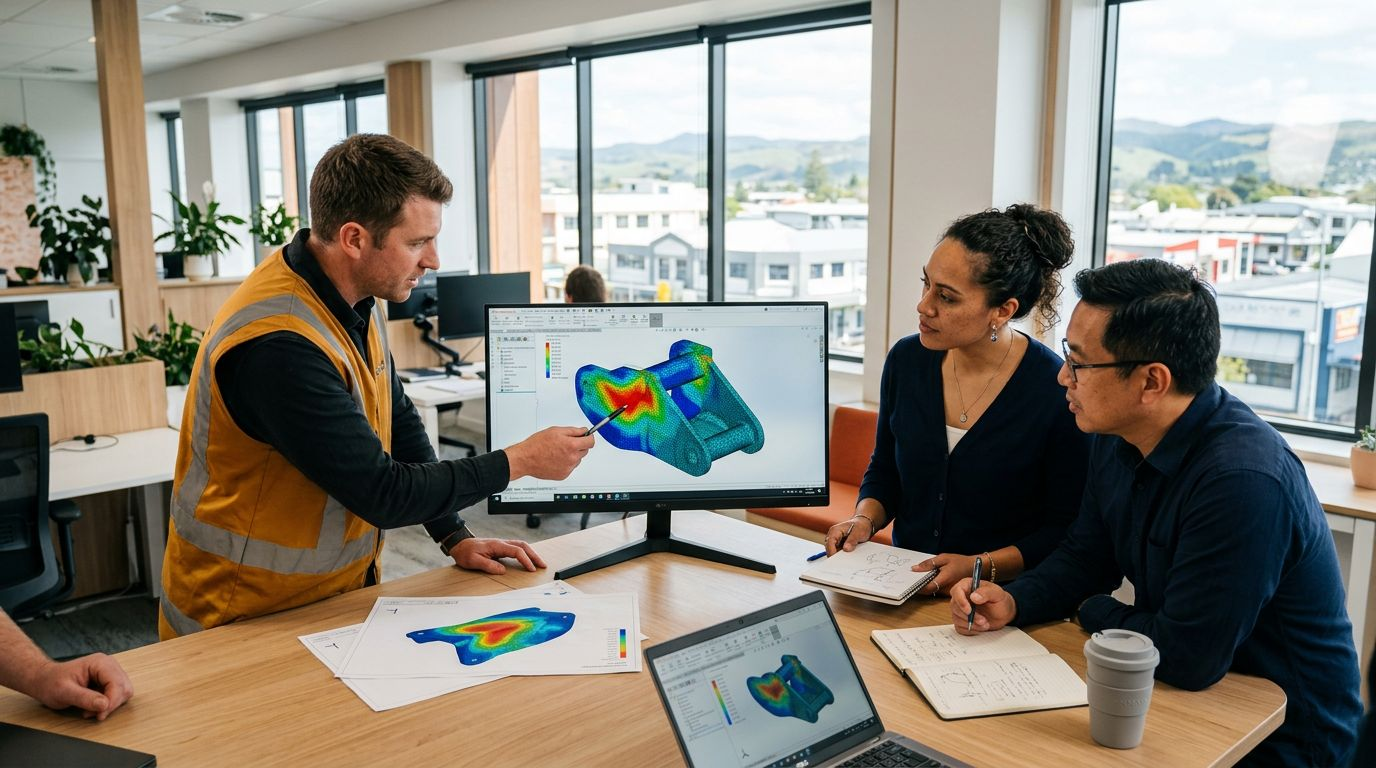
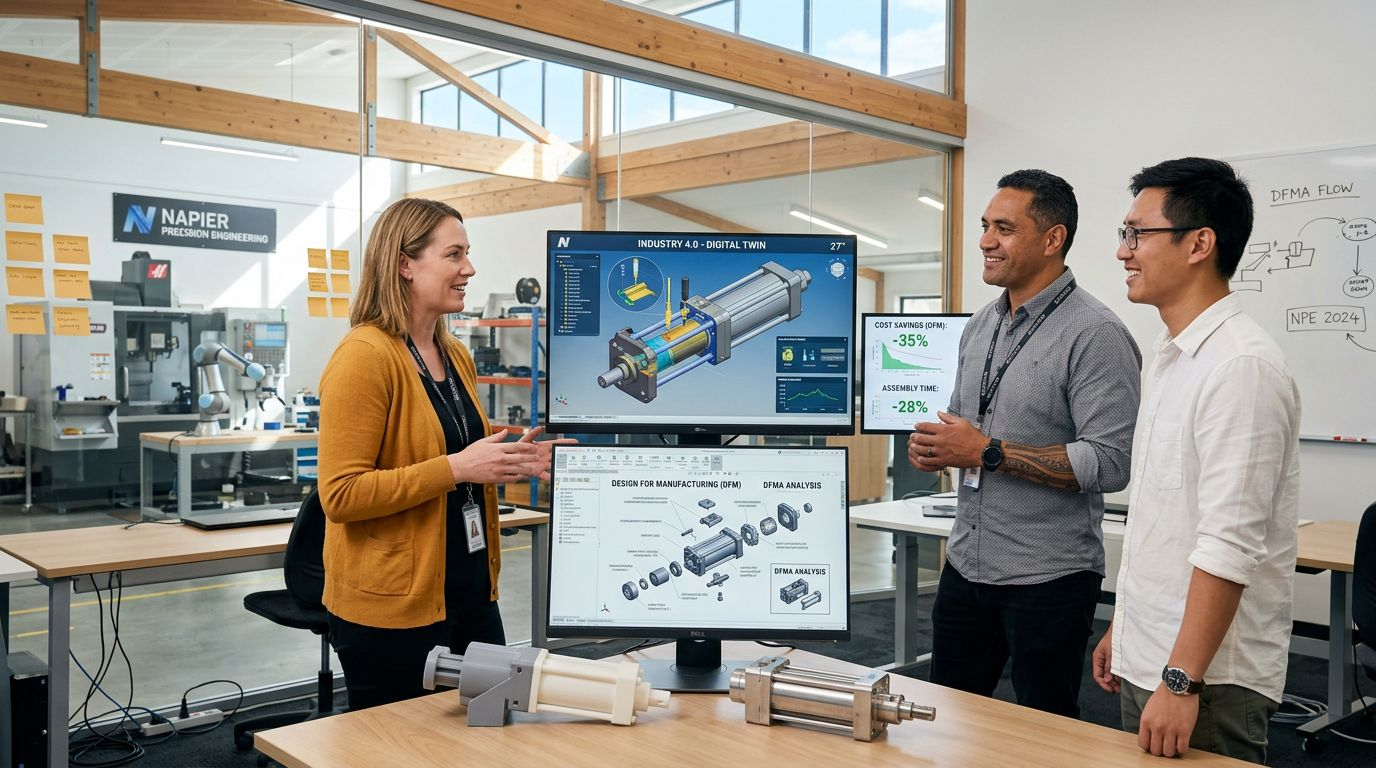
As we look toward the future, the integration of digital tools is making DFM even more powerful. Industry 4.0 technologies, such as advanced surface modelling and digital twins, allow us to test manufacturing scenarios in a virtual environment before a single cent is spent on materials. For New Zealand businesses, adopting these modern manufacturing engineering principles is the key to closing the productivity gap with our international peers.
The application of these principles can be seen in global leaders like BMW, who used DFM to cut manufacturing costs by 25% on a new electric vehicle platform compared to previous levels. While the scale of a Kiwi business might be different, the logic remains the same. Whether you are producing high-volume consumer goods or specialized industrial equipment, the principles of simplification, standardisation, and process alignment will always deliver value.
Partnering for Success
Building a successful product in New Zealand requires a blend of innovation, practical engineering, and a deep understanding of the local manufacturing ecosystem. We pride ourselves on being more than just a drafting service; we are a partner in your product’s success. By focusing on DFM, we help you de-risk your production, reduce your costs, and get your ideas to market faster.
If you are ready to take your concept to the next level, focusing on manufacturability is the best investment you can make. We invite you to explore how a structured approach to design can transform your business outcomes and help you compete on a global stage. Our goal is to provide the expertise and the "straight up" advice you need to navigate the complexities of modern product development with confidence.